Why Home Refurbs Become Overwhelming So Quickly
The home refurb decisions that look small until they start causing trouble
I have lost count of the number of times I have seen perfectly sensible, capable people become completely stuck, like a deer in the headlights, by a “quick question” from site. These are the home refurb decisions that look small at first, but quickly start causing trouble.
“Siobhan, I just don’t know what socket to choose. There are just soooo many choices!”
Not because they are indecisive or because they have no taste. Not because they should magically have known the answer.
But because the question is almost never as quick as it sounds.
Where do you want the sockets? Which sockets do you want to be USB sockets? Which way are we laying the tiles? Are you definitely having wall lights? If so, exactly where? What grout colour? Where is the mirror going? Is the mirror lit and therefore in need of a power supply? Do you want the towel rail centred on the wall, aligned with the height of the basin, or placed somewhere a human can actually reach it?
And there it is.
A perfectly regular person, who can run a business, manage a household, book a holiday, organise children, deal with elderly parents, hold down a job and generally function in society, is suddenly staring at a half-built bathroom wondering why the position of a towel rail has suddenly become the hardest thing to decide.
This is the bit of home refurbishment people do not talk about enough.
It is not always the big decisions that cause the most stress. Most people expect the kitchen, bathroom, flooring and layout to require proper thought. They know those things matter. They expect those conversations to take time.
It is often the smaller decisions that creep in sideways.
The socket position. The tile trim. The colour of the grout. The switch plate design, finish and location. The wall light height. The radiator colour. The door handle height. The question about whether something needs ordering now, or even yesterday, or whether it can wait.
Individually, none of these decisions sound especially dramatic. Collectively, they can start to feel like being pecked to death by very expensive ducks.
And the reason they become so stressful is simple: they are rarely isolated decisions.
A socket affects furniture layout. A wall light affects mirrors, artwork, beds, joinery and head height. A floor tile layout affects cuts, wastage, the actual quantity required, and whether the whole bathroom looks considered or faintly chaotic. A budget decision made too casually in week two can come back in week eight to bite you on the backside when you have no funds for the perfect chandelier you now cannot afford.
This is why home refurb decisions become overwhelming so quickly and, frankly, this is where things can start to go a bit feral.
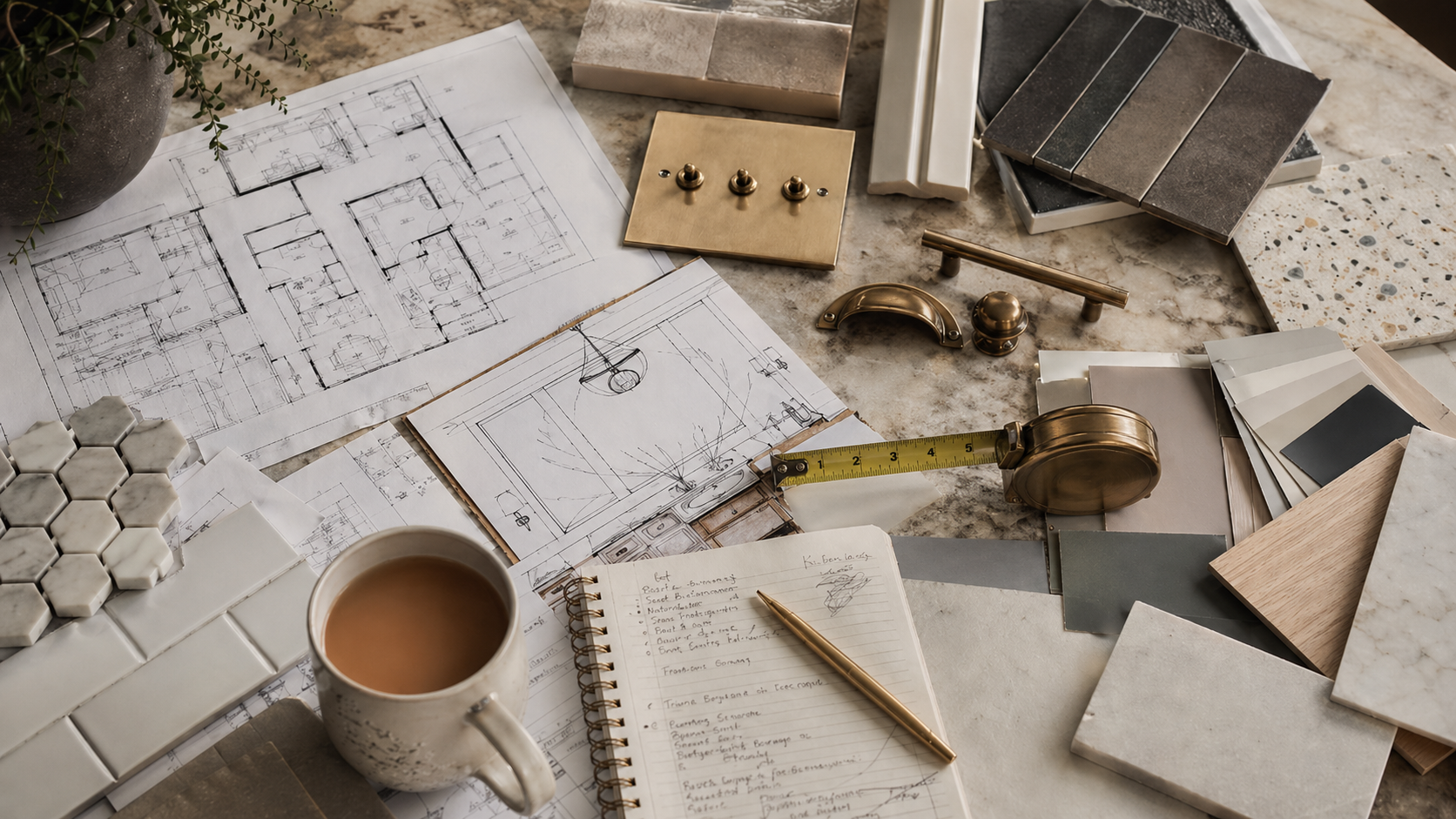
The “quick question” stage of a refurb, where sockets, tiles, lighting, finishes and budgets all start quietly demanding decisions at once.
The “quick question” is rarely quick
One of the biggest surprises for clients is how often a building project requires design decisions before the space feels ready for them.
In an ideal world, you would make every decision calmly, in the right order, with good lighting around you, a cup of tea, maybe even a chocolate digestive to hand, and no one standing nearby hovering to see if you have finally made your mind up about which wall the TV is going to go on.
In reality, the builder needs an answer because the next stage depends on it. The electrician needs to know where the cables are going. The bathroom tiler needs to set out the walls and finalise the quantity required. The plumber needs to know exactly what sanitaryware is being fitted and ideally have the technical spec in front of them so that they can identify any potential issues early. The decorator wants colours. Someone is asking about door architrave profiles. Someone else has found the internal doors are now out of stock for 16 weeks and needs to source them elsewhere or change the design.
This is where I often see people freeze, not because they do not care, but because they suddenly realise one answer may affect several other things.
If you say yes to moving a socket, does the furniture layout still work? If you change the vanity unit, does the mirror still fit? If the wall lights move, are they now too high for the artwork you have in mind? If you choose a different tile size, what happens to the layout around the window?
This is the slightly maddening thing about interiors. A room is a web of decisions pretending to be a collection of individual choices.
The issue is not taste. It is sequencing.
Most people know more about what they like than they think.
They know when something feels too cold, too bland, too fussy, too modern, too traditional, too show home, too much like a private dental clinic waiting room.
The difficulty is not always taste. It is sequencing.
What needs to be decided now? What can wait? What affects the build? What affects the furniture? What affects the budget? What affects the lighting? What is a genuine priority, and what is just shouting loudly because someone has asked about it today?
A good refurb is not decision-free. That would be lovely, but sadly we do not live in that fantasy.
A good refurb is decision-aware.
The right decisions need to be made at the right time, with enough context around them to stop everything becoming a daily game of design whack-a-mole.
And this is exactly why so many homeowners find themselves overwhelmed halfway through a project. They are not just choosing items. They are trying to make a chain of connected decisions while the clock is ticking, the budget is shifting, and someone is waiting for an answer.
That is a lot for anyone.
The problem with home refurb decisions is that they rarely arrive in a neat, sensible order.
The decisions that deserve more attention
This is the first in a short series about the home refurb decisions that look small until they start causing trouble.
Over the next few posts, I’ll be looking at the areas that most often trip people up, starting with lighting.
Lighting is one of my everlasting frustrations because people often think they can come back to it later. They choose the kitchen. They choose the tiles. They choose the bathroom fittings. They save a few lovely wall lights on Instagram and tell themselves they will deal with lighting once the main decisions are out of the way.
Then the electrician arrives.
Suddenly, lighting is no longer a lovely future decision. It is a practical site question involving cables, switches, ceiling heights, wall chasing and a trade in dusty boots waiting for an answer.
I’ll also be talking about budget, because the builder’s quote is not the whole budget, however reassuringly official it may look. VAT, delivery charges, upgraded finishes, lighting fixtures, window treatments, ironmongery, furniture and all the supposedly “small” finishing details have a habit of quietly joining the party.
Then there are tiles, which look straightforward but absolutely are not. Size, layout, direction, grout colour, trims, edges, cuts, niches, thresholds, wastage and lead times can turn one sample tile into a small administrative department.
And finally, I’ll be talking about the finishing details. The things that tend to arrive when everyone is tired, slightly dusty, over budget and dangerously close to saying, “Let’s just get something.”
That is often where the finish starts to slip.
Before it all gets a bit feral
If you are planning a refurb, it is worth doing some joined-up thinking before work starts. Not because every single detail needs to be locked down in advance, because that can become rigid and joyless, but because the important decisions need to be identified early.
Lighting strategy. Electrical positions. Plumbing positions. Tile choices and layouts. Key finishes. Larger furniture pieces. Storage. Window treatments. Budget exclusions. The things that are definitely included. The things that are absolutely not included but will still need paying for eventually.
The point is not to suck all the life out of the project with a giant spreadsheet of doom, but to avoid making expensive decisions in a rush, in the wrong order, while standing in an ironmongery shop having an existential wobble over brushed brass versus antique brass.
And if you are already in the middle of it, the answer is not to panic or keep guessing. It is to pause, work out which decisions are connected, and decide what needs to be solved first.
This is exactly the sort of stage where getting experienced eyes on the project can make a real difference.
Not to take over. Not to make it more complicated. Just to help you see what matters, what can wait, what needs deciding now, and where you might be about to make life unnecessarily difficult for yourself.
Next in the series: lighting
In the next post, I’ll be looking properly at lighting, because this is one of the areas where small decisions can become expensive very quickly.
Not just which lovely pendant you have saved on Instagram, but where the lights are going, how they are switched, what needs to be lit, what should absolutely not be lit like a hospital corridor, and why “we’ll sort lighting later” is one of those phrases that makes me quietly twitch.
Because by the time the electrician is asking where the cables are going, lighting is no longer a future decorative choice. It is a site decision.
And site decisions have a habit of becoming urgent before anyone feels emotionally ready for them.
Need help making sense of the chaos?
If your home refurb decisions are starting to feel tangled, and you need to make umpteen decisions about lighting, tiles, budget, finishes, layout tweaks, or all of the above, my Build Survival Session was created for exactly this point.
It is a focused virtual consultation where we look at where you are stuck, what decisions need to be made, and how to move forward without spiralling into yet another evening of sample-induced despair.
You send me your plans, photos, videos and as well as a completed questionnaire, I review everything in depth beforehand, then over zoom we work through the priorities together so you can make clearer decisions and keep the project moving.
You also get four weeks of WhatsApp support afterwards, so if another “quick question” pops up once the dust settles, or more likely while the dust is still very much present, you are not left completely on your own.
Very useful if your builder needs answers.
Even more useful if you and your partner have started communicating entirely through screenshots and passive-aggressive grout samples.
A little birthday offer
To celebrate 14 years of Casey & Fox, I’m offering
14% off your first online consultation
when it is booked and paid for
before midnight 30 April 2026.
The consultation itself does not need to take place in April.
It can be booked for any date up to 90 days from the date of booking.
Project Galleries